DTG vs Screen Printing Differences And Which Method Is Better
The debate over dtg vs screen printing has become increasingly relevant as custom apparel printing continues to grow in popularity. Whether you’re a small business owner launching a clothing line, an artist looking to reproduce your designs on fabric, or simply someone interested in creating custom merchandise, understanding the fundamental differences between direct to garment printing and the traditional screen printing method can save you time, money, and frustration. These two dominant printing techniques represent different approaches to transferring designs onto fabric, each with distinct advantages, limitations, and ideal use cases. This comprehensive guide will explore every aspect of both methods, from the printing setup and equipment costs to print quality and durability, helping you make an informed decision about which approach best suits your specific needs.
Quick Overview: DTG vs Screen Printing
Key Takeaways:
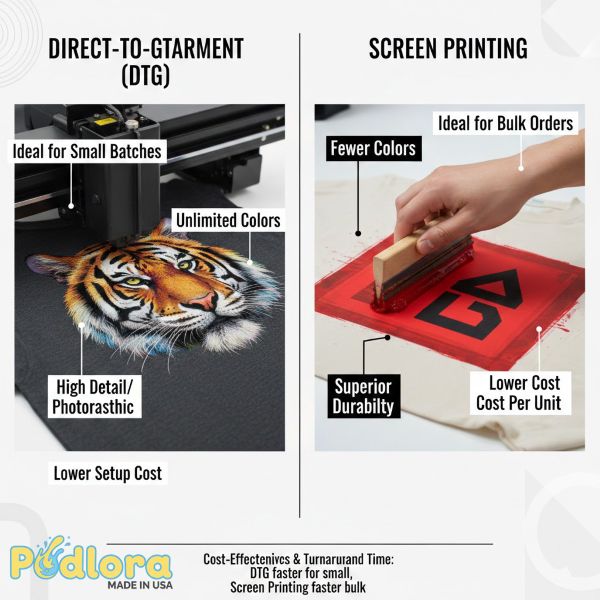
- DTG printing uses inkjet technology to print designs directly onto garments, ideal for small batch printing and highly detailed, photorealistic designs with unlimited colors
- Screen printing uses mesh screens and ink layers pressed through stencils, perfect for bulk orders with simple designs and offering superior print durability for high-volume production
- Cost structure differs significantly: DTG has lower setup costs but higher per-unit costs, while screen printing requires expensive initial setup but becomes cost-effective for large orders
- Turnaround time: DTG offers faster production for small orders and on-demand printing, while screen printing requires longer setup but faster per-unit production for bulk quantities
- Print quality considerations: DTG excels at color complexity and intricate details, while screen printing delivers bolder, more vibrant colors with better wash durability
The Evolution of Garment Printing Technologies
The Screen Printing Legacy
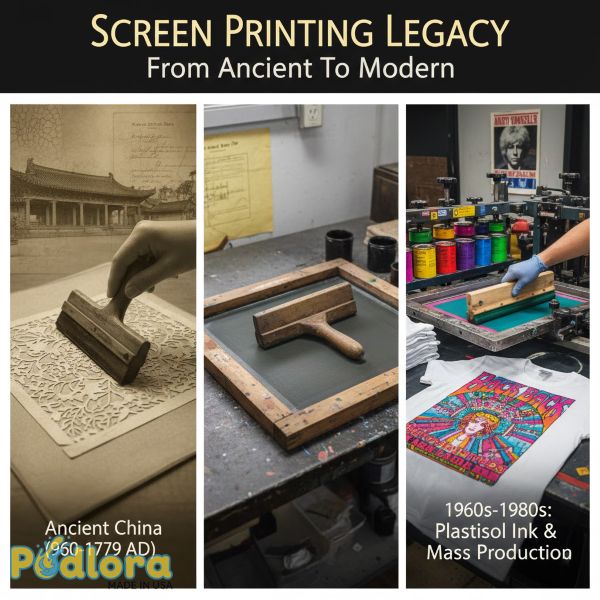
Screen printing has dominated the custom apparel printing industry for over a century. The technique traces its origins to ancient China during the Song Dynasty (960-1279 AD), though the modern screen printing process as we know it emerged in the early 20th century. According to textile printing historians, Samuel Simon patented the first modern screen printing system in England in 1907, revolutionizing how designs could be transferred onto fabric and other materials.
By the 1960s, screen printing had become the standard for commercial garment decoration, particularly as the counterculture movement created demand for custom t-shirts and artistic apparel. The introduction of plastisol ink in the 1960s further transformed the industry, offering better opacity, durability, and ease of use compared to earlier water-based inks. Throughout the 1970s and 1980s, screen printing technology advanced with improved mesh screens, better emulsion formulas, and more efficient curing processes, cementing its position as the go-to method for production-level custom t-shirt printing.
The DTG Revolution
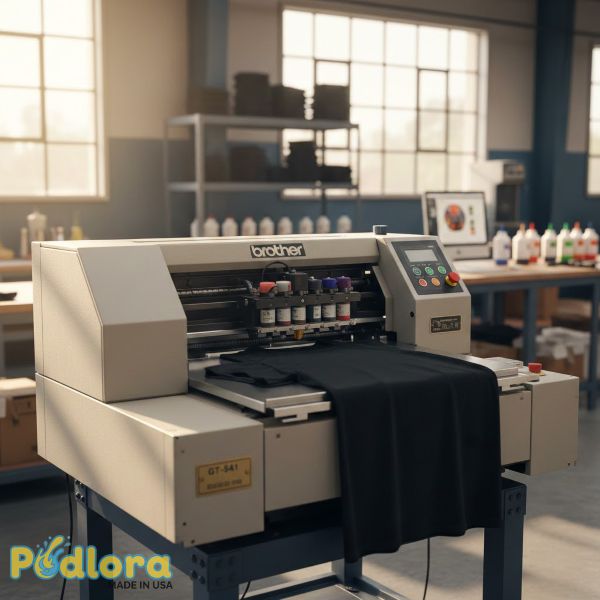
Direct to garment printing represents a much more recent innovation in fabric printing technology. The first commercial DTG printer was introduced in 1996 by Matthew Rhome, who filed the first DTG patent that year. His machine, called the “Revolution,” demonstrated the feasibility of using inkjet technology to print directly onto cotton t-shirts. However, the technology didn’t gain significant traction until the mid-2000s when Brother Industries released the GT-541 in 2005, marking the first ground-up DTG printer with printheads and electronics specifically designed for garment printing.
The technology works similarly to a standard desktop inkjet printer but uses specialized water-based inks formulated to bond with fabric fibers. Early DTG printers struggled with consistency, maintenance issues, and limited fabric compatibility, particularly on dark garments. A major breakthrough came at the end of 2005 when U.S. Screen released white ink developed by DuPont, finally enabling printing on dark-colored garments by providing an underbase layer.
Current Industry Landscape
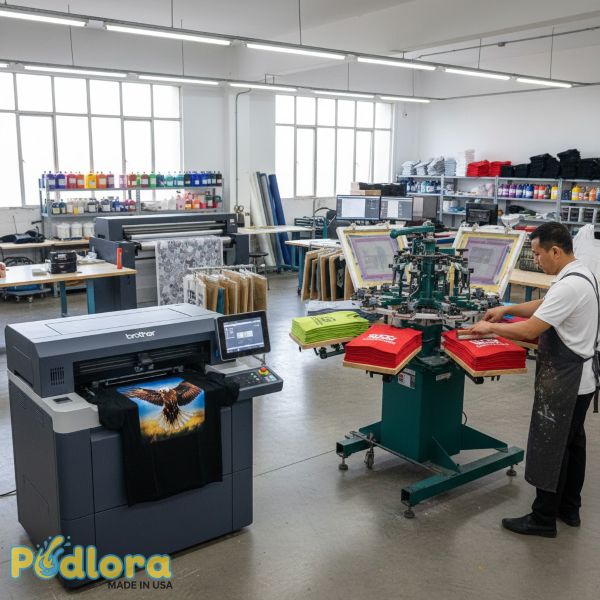
As of 2025, both printing methods coexist and serve different market segments. According to recent market research, the global digital textile printing market (which includes DTG) was valued at approximately $2.85-3.8 billion in 2024-2025 and is projected to grow at rates between 7-12% annually through 2030-2035, driven by increasing demand for customization, on-demand printing, and sustainable production methods.
Meanwhile, traditional screen printing remains dominant for large-scale production, particularly in the promotional products industry where bulk orders are the norm. The rise of e-commerce and print-on-demand businesses has accelerated DTG adoption, as online retailers need flexible, low-inventory solutions for custom apparel. Conversely, screen printing continues to thrive in established apparel manufacturing, corporate uniform production, and any application requiring thousands of identical prints with maximum durability.
Understanding the Screen Printing Method
How Screen Printing Works
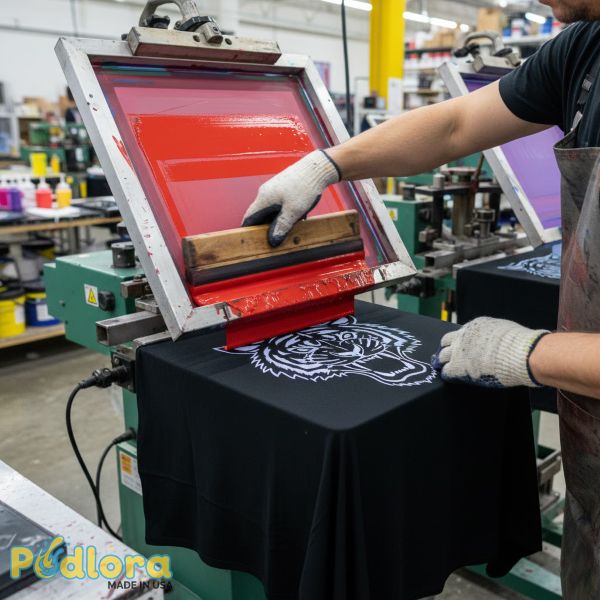
The screen printing process is a relatively straightforward mechanical technique that uses a mesh screen as a stencil to transfer ink onto fabric. Each color in a design requires a separate screen, making the setup process time-intensive but enabling consistent reproduction across thousands of garments.
The Screen Printing Process Step-by-Step:
- Design preparation: The artwork is separated into individual color layers, with each color requiring its own screen
- Screen creation: A fine mesh screen (typically made from polyester or nylon) is coated with light-sensitive emulsion
- Exposure: The design is burned onto the screen using UV light, hardening the emulsion everywhere except where the design appears
- Washing: The unexposed emulsion is washed away, leaving open mesh in the shape of the design
- Setup: The screen is mounted on a printing press, and the garment is positioned on a platen underneath
- Ink application: Plastisol ink or water-based ink is poured onto the screen and spread across using a squeegee, forcing ink through the open mesh areas onto the fabric below
- Curing process: The printed garment passes through a heat tunnel or conveyor dryer at temperatures typically between 320-330°F to cure plastisol ink, ensuring permanent adhesion
Screen Printing Advantages
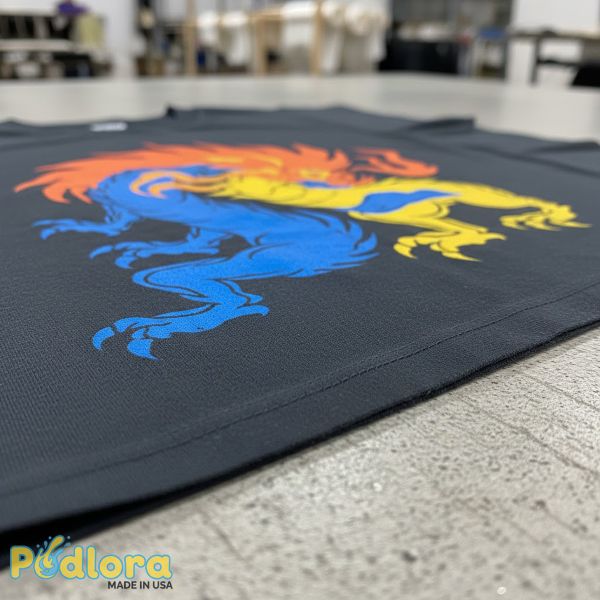
Superior durability: Screen printed designs, particularly those using plastisol ink, can withstand 40-50 wash cycles or more without significant fading when properly cured, making them ideal for athletic wear, work uniforms, and frequently washed garments.
Vibrant colors: The thick ink deposit creates bold, opaque colors that pop against both light and dark fabrics. The opacity of screen printed inks means colors appear exactly as intended regardless of the garment color underneath.
Cost-effective for bulk orders: Once screens are created and the press is set up, the printing cost per unit drops dramatically. High-volume runs of 100+ identical garments become increasingly economical, with per-shirt costs potentially dropping below $2 for simple designs.
Versatile ink options: Screen printers can use specialty inks including metallic, glow-in-the-dark, puff (raised texture), glitter, and even discharge inks that remove fabric dye to create soft, vintage-style prints.
Production speed for volume: Modern automatic screen printing presses can produce 300-500 prints per hour once setup is complete, making them unmatched for large production runs.
Screen Printing Limitations
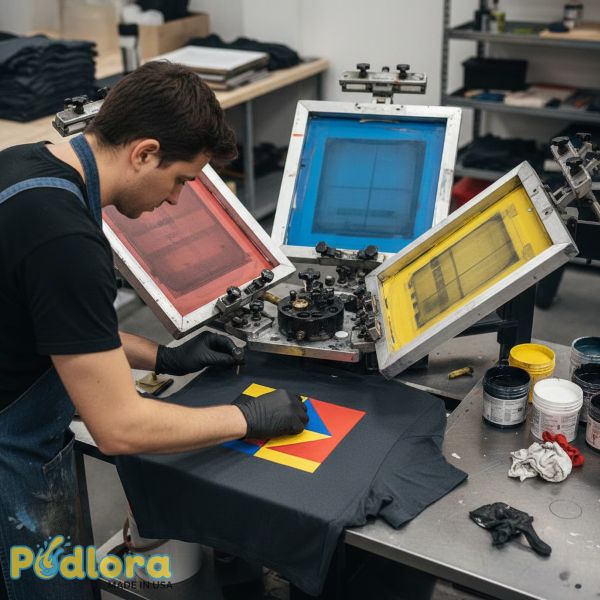
High setup costs: Creating screens for each color in a design represents a significant upfront investment, typically ranging from $15-50 per screen depending on complexity and size. Multi-color designs can require setup fees of $100-300 or more.
Color limitations: Each additional color increases setup time and cost. Most screen printers charge per color, making designs with high color complexity economically impractical. Full-color photographic designs are essentially impossible with standard screen printing.
Minimum order requirements: The high setup costs make small orders uneconomical. Most screen printing shops require minimum orders of 24-50 pieces to justify the setup expense.
Design complexity restrictions: Fine details, gradients, and photorealistic images cannot be accurately reproduced. Screen printing works best for bold, simple designs with clear color separations.
Setup time: Creating screens, mixing inks, and calibrating the press can take several hours or even days for complex multi-color jobs, making rush orders difficult.
Understanding Direct to Garment Printing
How DTG Printing Works
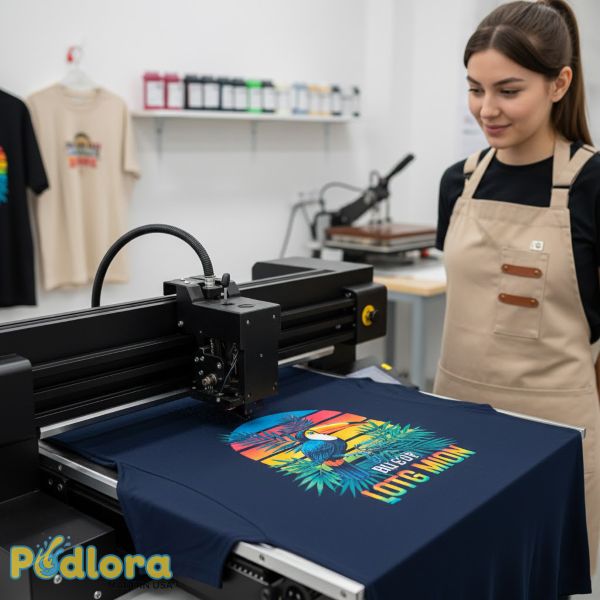
Direct to garment printing uses modified inkjet technology specifically engineered for textile applications. A DTG printer functions similarly to a standard desktop printer but uses specialized water-based inks that chemically bond with fabric fibers rather than sitting on top of the material.
The DTG Printing Process Step-by-Step:
- Design preparation: The artwork is prepared digitally using graphic design software, with no color separation required since DTG printers handle all colors simultaneously
- Pre-treatment process: For dark garments, a pre-treatment solution is applied to the fabric to help the ink adhere properly and prevent it from soaking into the fibers (not required for light-colored garments)
- Garment loading: The shirt is positioned on the printer’s platen and smoothed to eliminate wrinkles that could affect print quality
- Printing: The DTG printer’s printhead moves across the garment, depositing microscopic droplets of water-based inks directly onto the fabric in a single pass or multiple passes depending on the printer model
- Curing: The printed garment is heat-pressed or run through a conveyor dryer at approximately 330°F for 30-60 seconds to cure the inks and ensure colorfastness
- Quality check: The finished print is inspected and any excess pre-treatment residue is removed
DTG Printing Advantages
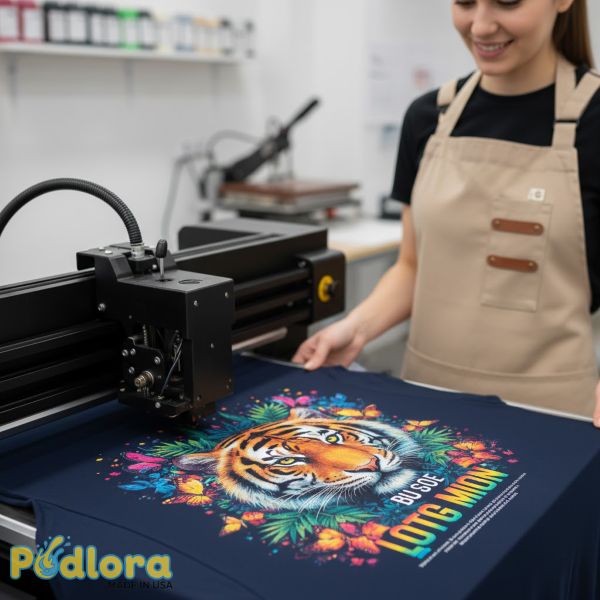
No setup costs: Unlike screen printing, DTG requires no screens, stencils, or color-specific preparation. You can print a single shirt as easily as printing 100, making it ideal for small batch printing and on-demand printing business models.
Unlimited color complexity: DTG printers can reproduce millions of colors in a single print job, making them perfect for photorealistic designs, detailed artwork, intricate illustrations, and full-color photographs without any price increase.
Fine detail reproduction: The high resolution of modern DTG printers (up to 1200 dpi or higher) allows for incredibly detailed designs with sharp lines, small text, and subtle gradations that would be impossible with screen printing.
Quick turnaround time: A single garment can be designed, printed, and cured in under 10 minutes, making DTG ideal for rapid prototyping, same-day orders, and rush jobs.
Design flexibility: Since no physical screens are required, designs can be easily modified, personalized, or completely changed between prints with no additional cost or setup time.
Lower barrier to entry: Starting a DTG printing business requires less space, fewer specialized skills, and lower initial investment than setting up a screen printing operation, making it accessible for small businesses and entrepreneurs.
DTG Printing Limitations
Higher printing cost per unit: While there are no setup fees, the cost of ink, pre-treatment, and slower production speed means DTG prints typically cost $3-10 per garment depending on design size and color coverage, making large orders more expensive than screen printing.
Slower production speed: Most DTG printers produce 15-30 garments per hour, significantly slower than automated screen printing presses, making very large orders time-prohibitive.
Fabric limitations: DTG works best on 100% cotton or cotton-poly blends with high cotton content (at least 50-60%). Water-based inks don’t bond well with synthetic fibers like polyester and nylon, often producing poor results on these materials.
Dtg printing on dark fabrics challenges: Printing on dark colors requires pre-treatment, uses significantly more ink (including an underbase white layer), and can sometimes result in a slightly stiffer feel compared to printing on light garments.
Print durability concerns: While modern DTG prints are quite durable, they generally don’t last as long as properly cured screen prints. DTG designs may begin to fade after 20-30 wash cycles, though proper care can extend this considerably.
Maintenance requirements: DTG printers require regular maintenance including print head cleaning, ink line flushing, and occasional print head replacement to prevent clogging and maintain print quality.
Side-by-Side Comparison: Which Method Is Better?
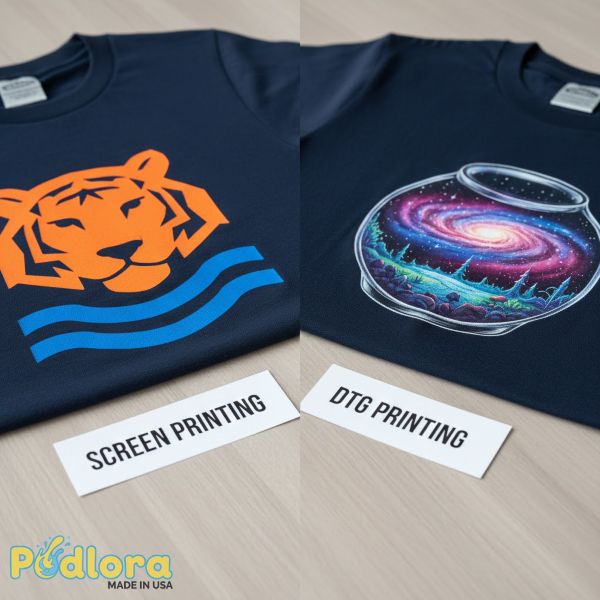
Cost Analysis: DTG vs Screen Printing Cost Comparison
Understanding the cost structure of each printing method is crucial for making an informed decision.
Screen Printing Costs:
- Setup fees: $15-50 per color/screen
- Per-garment cost: $2-5 for simple designs in bulk orders (100+ units)
- Break-even point: Typically economical at 50+ identical units
- Large orders (500+ units): Can drop below $2 per shirt
- Example: 100 three-color shirts might cost $150 setup + $350 printing = $5 per shirt total
DTG Printing Costs:
- Setup fees: None
- Per-garment cost: $5-12 depending on design complexity and garment color
- Light-colored garments: $5-7 per print
- Dark-colored garments: $8-12 per print (due to pre-treatment and additional ink)
- Example: 100 full-color shirts might cost $6-8 per shirt regardless of color count
Break-Even Analysis: For simple 1-2 color designs, screen printing becomes more cost-effective around 50-75 units. For complex multi-color designs, DTG remains competitive even at 100+ units because screen printing setup costs scale with color count.
Quality Comparison: Print Quality and Durability
Visual Quality:
- DTG: Superior for photorealistic designs, gradients, and detailed artwork; can reproduce subtle color variations and fine details down to 1200 dpi
- Screen Printing: Superior for bold, solid colors with maximum vibrancy; colors appear brighter and more saturated, particularly on dark garments
Print Durability: Screen printed designs using plastisol ink typically maintain excellent color retention through 40-50+ wash cycles, while DTG prints generally maintain good quality through 20-30 wash cycles when both are properly cured and washed according to care instructions. Both methods require proper care: washing inside-out in cold water, avoiding bleach, and line drying or low-heat tumble drying.
Feel and Texture:
- Screen printing: Creates a noticeable layer of ink on top of the fabric, giving prints a slightly raised texture; heavier ink deposits can feel stiff or plasticky, particularly with multiple colors
- DTG: Inks absorb into fabric fibers, creating a softer feel that doesn’t change the hand (feel) of the garment significantly; prints are generally imperceptible to touch on light garments
Production Speed and Turnaround Time
DTG Printing Turnaround Time:
- Single garment: 5-10 minutes from file to finished print
- Small orders (1-24 pieces): Same day or next day typically possible
- Medium orders (25-100 pieces): 1-3 days production time
- Ideal for: Rush orders, prototypes, test runs, on-demand printing
Screen Printing Production Speed:
- Setup time: 2-8 hours depending on design complexity
- Production: 300-500 units per hour once running
- Small orders (24-50 pieces): 3-5 days including setup
- Large orders (500+ pieces): 5-10 days production time
- Ideal for: Planned events, bulk inventory, wholesale orders
Best Printing Method for Different Scenarios
Choose DTG printing when:
- Order quantity is under 50 units
- Design includes photographic images or complex gradients
- Design uses more than 4-5 colors
- Personalization is required (individual names, numbers, custom text)
- Quick turnaround is critical (24-48 hours)
- Testing new designs before committing to bulk production
- Operating an on-demand or print-as-you-sell business model
Choose screen printing when:
- Order quantity exceeds 50-100 identical units
- Design uses 1-3 solid colors with simple artwork
- Maximum durability is required (athletic wear, work uniforms)
- Budget per unit must be minimized on bulk orders
- Design includes specialty effects (metallic, glow, puff, glitter)
- Printing on non-cotton fabrics like polyester performance wear
- Producing merchandise for resale with consistent branding
Environmental Considerations: DTG vs Screen Printing Environmental Impact
Water-based inks used in DTG printing are generally considered more environmentally friendly than traditional plastisol ink, as they contain fewer harsh chemicals and VOCs (volatile organic compounds). However, DTG requires pre-treatment chemicals for dark garments and generates electronic waste from printer components.
Screen printing using water-based inks (rather than plastisol) can be quite sustainable, but the screen cleaning process generates chemical waste. Modern screen printing shops increasingly use water-based and discharge inks to reduce environmental impact.
Both methods require energy for curing, though DTG’s lower temperature and shorter curing time may use slightly less energy per unit. For environmentally conscious operations, both methods can be implemented sustainably with proper waste management and eco-friendly ink choices.
Practical Considerations for Custom Apparel Businesses
Equipment Investment and Space Requirements
DTG Printer Setup:
- Entry-level DTG printer: $10,000-20,000
- Professional-grade DTG printer: $30,000-80,000
- Heat press for curing: $500-2,000
- Pre-treatment equipment: $500-3,000
- Space requirements: 100-200 square feet minimum
- Ventilation: Standard HVAC adequate for most setups
Screen Printing Setup:
- Manual press (4-6 color): $800-3,000
- Automatic press: $15,000-100,000+
- Exposure unit: $500-5,000
- Conveyor dryer: $3,000-15,000
- Screen making supplies: $1,000-3,000
- Space requirements: 300-1,000 square feet depending on scale
- Ventilation: Professional ventilation system recommended
Learning Curve and Skill Requirements
Which printing method is best for beginners? DTG printing has a significantly lower learning curve. The digital workflow is intuitive for anyone familiar with graphic design software, and the printing process itself is largely automated. Most beginners can produce acceptable prints within a few hours of training.
Screen printing requires mastering multiple interconnected skills: screen preparation, color mixing, registration (alignment), squeegee technique, and ink curing. Achieving consistent, professional results typically requires weeks or months of practice. However, once mastered, screen printing offers greater creative control and production efficiency.
Maintenance and Operating Costs
DTG Maintenance:
- Daily print head cleaning: 15-30 minutes
- Weekly deep cleaning: 1-2 hours
- Print head replacement: $500-2,000 every 12-24 months depending on usage
- Ink costs: $0.50-3.00 per print depending on size and color coverage
- Pre-treatment costs: $0.30-0.80 per dark garment
Screen Printing Maintenance:
- Screen reclamation after each job: $2-5 per screen in chemicals and labor
- Ink waste from cleanup: 5-10% of ink usage
- Squeegee and screen replacement: Approximately $500-1,000 annually for active shops
- Press maintenance: Minimal, primarily lubrication and occasional part replacement
Choosing the Right Method for Your Needs
Assessment Framework
To determine which printing method is better for custom t-shirts in your specific situation, answer these key questions:
Volume Questions:
- How many pieces do you need per design? (Under 50 = DTG; Over 100 = Screen printing)
- Will you reprint the same design multiple times? (Yes = Screen printing advantage)
- Do you need quick turnaround or planned production? (Quick = DTG; Planned = Either)
Design Questions:
- How many colors does your design include? (6+ colors = DTG; 1-3 colors = Screen printing)
- Does your design include photographic images or complex gradients? (Yes = DTG)
- Do you need specialty effects like metallics or textures? (Yes = Screen printing)
Business Model Questions:
- Are you operating print-on-demand or holding inventory? (On-demand = DTG)
- Is your budget focused on per-unit cost or setup cost? (Per-unit = Screen printing for volume)
- Do you need personalization capability? (Yes = DTG)
Hybrid Approaches
Many successful custom apparel businesses use both methods strategically:
- Sample production in DTG, bulk production in screen printing: Create prototypes and test designs with DTG, then switch to screen printing when a design proves popular and orders scale up
- DTG for complex designs, screen printing for simple logos: Match each design to its most economical method
- Seasonal flexibility: Use DTG during busy seasons to manage overflow, use screen printing for planned bulk orders during slower periods
| Factor | DTG Printing | Screen Printing |
|---|---|---|
| Setup Costs | $0 (no setup required) | $15-50 per color/screen ($100-300+ for multi-color designs) |
| Per-Unit Cost | $5-12 per garment | $2-5 per garment (bulk orders) |
| Minimum Order | 1 piece (no minimum) | 24-50 pieces typically required |
| Ideal Order Size | 1-50 units | 100+ units |
| Color Limitations | Unlimited colors at same price | Each color adds setup cost and complexity |
| Design Complexity | Excellent for detailed, photorealistic designs | Best for simple, bold designs with 1-4 colors |
| Print Resolution | Up to 1200+ dpi | Lower resolution, limited fine detail |
| Setup Time | 5-10 minutes | 2-8 hours for screen creation and press setup |
| Production Speed | 15-30 garments/hour | 300-500 garments/hour (once setup complete) |
| Turnaround Time | Same day to 1-3 days | 3-10 days (including setup) |
| Print Durability | 20-30 wash cycles at high quality | 40-50+ wash cycles at high quality |
| Best Fabric Types | 100% cotton or 50%+ cotton blends | Works on all fabrics (cotton, polyester, blends) |
| Dark Fabric Printing | Requires pre-treatment; higher cost | Excellent opacity; no additional steps |
| Print Feel/Texture | Soft, absorbed into fabric | Slightly raised, thicker ink layer |
| Specialty Effects | Limited (standard ink only) | Extensive (metallic, glow, puff, glitter, discharge) |
| Personalization | Easy (names, numbers, custom text) | Difficult and expensive |
| Equipment Investment | $10,000-80,000 for printer + accessories | $5,000-100,000+ for complete setup |
| Space Requirements | 100-200 sq ft | 300-1,000 sq ft |
| Learning Curve | Low (2-5 days to proficiency) | High (weeks to months for mastery) |
| Maintenance | Daily cleaning (30 min); print head replacement ($500-2,000/year) | Minimal; screen reclamation per job ($2-5/screen) |
| Environmental Impact | Water-based inks (more eco-friendly); requires pre-treatment chemicals | Can use water-based inks; screen cleaning creates chemical waste |
| Best Use Cases | • Small batch orders<br>• On-demand printing<br>• Complex/photorealistic designs<br>• E-commerce/POD businesses<br>• Prototypes & samples<br>• Personalized merchandise | • Bulk orders (100+ pieces)<br>• Simple logo designs<br>• Athletic/team uniforms<br>• Corporate apparel<br>• Retail merchandise<br>• Maximum durability needs |
| Cost-Effective At | Orders under 50 pieces | Orders over 100 pieces |
| Break-Even Point | N/A (flat cost per unit) | 50-75 units for simple designs |
Frequently Asked Questions
How long do DTG prints last compared to screen prints?
Properly cured screen prints using plastisol ink typically last 40-50+ washes while maintaining 90% of original quality, whereas DTG prints generally last 20-30 washes at that same quality level. However, DTG print longevity has improved significantly with modern inks and curing techniques. Both methods require proper care: washing inside-out in cold water, avoiding bleach, and line drying or low-heat tumble drying will maximize the life of any printed garment.
What’s the minimum order for screen printing vs DTG?
DTG printing has no minimum order—you can print a single shirt economically. Screen printing typically requires minimums of 24-50 pieces to justify the setup costs, though some shops will accept smaller orders at premium pricing. The economic break-even point where screen printing becomes cheaper than DTG is typically around 50-75 identical units for simple designs, or 100+ units for complex multi-color designs.
Can DTG print on polyester and other synthetic fabrics?
DTG works best on 100% cotton or cotton-poly blends with at least 50-60% cotton content. Pure polyester and other synthetic fabrics produce poor results with standard DTG water-based inks because the inks don’t chemically bond with synthetic fibers. Specialized DTG inks for polyester exist but are less common. Screen printing with plastisol ink works well on polyester, making it the better choice for athletic wear and performance fabrics.
Which printing method is more durable for athletic wear?
Screen printing using plastisol ink is significantly more durable for athletic wear that undergoes frequent washing and heavy use. The thick ink deposit resists cracking and fading even through repeated wash cycles and stretching. For performance polyester fabrics specifically, screen printing is often the only viable option as DTG doesn’t adhere well to synthetic materials.
What are the pros and cons of each method for a new business?
DTG Pros: Lower startup investment, no minimum orders, easy to learn, design flexibility, quick turnaround, perfect for e-commerce and print-on-demand models. DTG Cons: Higher per-unit costs, slower production, fabric limitations, ongoing maintenance.
Screen Printing Pros: Very low per-unit cost at volume, superior durability, works on any fabric, faster bulk production, specialty ink options. Screen Printing Cons: High setup costs, minimum order requirements, limited detail capability, longer production timeline, steeper learning curve.
How do setup costs compare for a multi-color design?
For a six-color design on 100 shirts: Screen printing might cost $250-350 in setup fees plus $300-400 in printing for a total of $550-750 ($5.50-7.50 per shirt). DTG would have $0 setup but cost $600-800 in direct printing costs ($6-8 per shirt). Screen printing’s advantage grows dramatically with higher quantities—at 500 shirts, screen printing drops to $2.50-3.50 per shirt while DTG remains at $6-8.
Conclusion
The choice between dtg vs screen printing ultimately depends on your specific needs, order volume, design complexity, and business model. Direct to garment printing excels in scenarios requiring design flexibility, low minimum orders, quick turnaround, and photorealistic detail, making it ideal for e-commerce businesses, custom merchandise on demand, and small-scale production. The screen printing method remains unbeatable for bulk orders requiring maximum durability, solid vibrant colors, and the lowest possible per-unit costs, particularly for designs with limited color palettes.
Modern custom apparel businesses often benefit from understanding both techniques and strategically applying each where it makes the most sense. As technology continues advancing, the gap between these methods narrows—DTG durability improves while screen printing becomes more accessible—but the fundamental economics and technical characteristics ensure both will remain relevant for different applications. Whether you’re printing a single personalized gift or producing thousands of team uniforms, selecting the appropriate printing technique will directly impact your costs, quality, and customer satisfaction.
Consider starting with whichever method aligns best with your initial business model, but remain open to incorporating the other technique as your needs evolve. Many successful print shops began with one method and strategically expanded to offer both, giving customers comprehensive solutions while maximizing their own operational efficiency and profitability.
Sources & References
- Wikipedia – Screen Printing and Direct-to-Garment Printing
- Brother DTG – History of DTG Printing
- ColDesi – History of Direct to Garment Printing
- Polyprint DTG – What is Direct to Garment Printing
- Coherent Market Insights – Digital Textile Printing Market Analysis
- Mordor Intelligence – Digital Textile Printing Market Report

Hi, I’m Emma Sullivan — a Texas-based writer who specializes in product design, e-commerce, and customer experience. With over five years of writing experience, I love turning complex information into clear, helpful content that makes online shopping easier for everyone. Having spent years working in the U.S. print-on-demand and merchandising space, I focus on creating articles that are honest, engaging, and genuinely useful.